Taking an RV off-grid requires a reliable power source, and solar energy is the quietest, lowest-maintenance option available. This guide breaks down manufacturer specifications, equipment costs, and electrical realities to help you size a system properly for 2026. You will learn the exact math required to calculate your daily loads, the strict physical limits of high-draw appliances like air conditioners, and what you must verify before paying for heavy hardware.
What Are RV Solar Panels and How Do They Power Your Adventures?
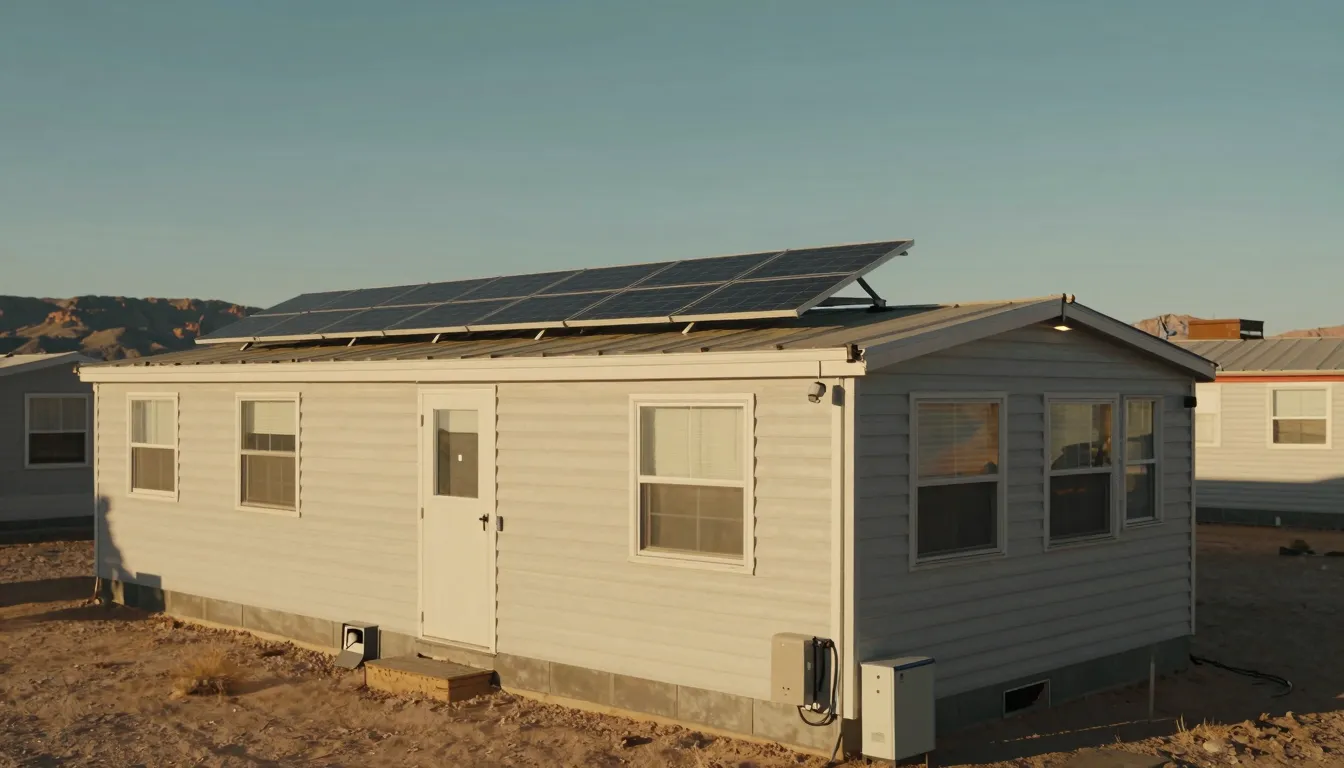
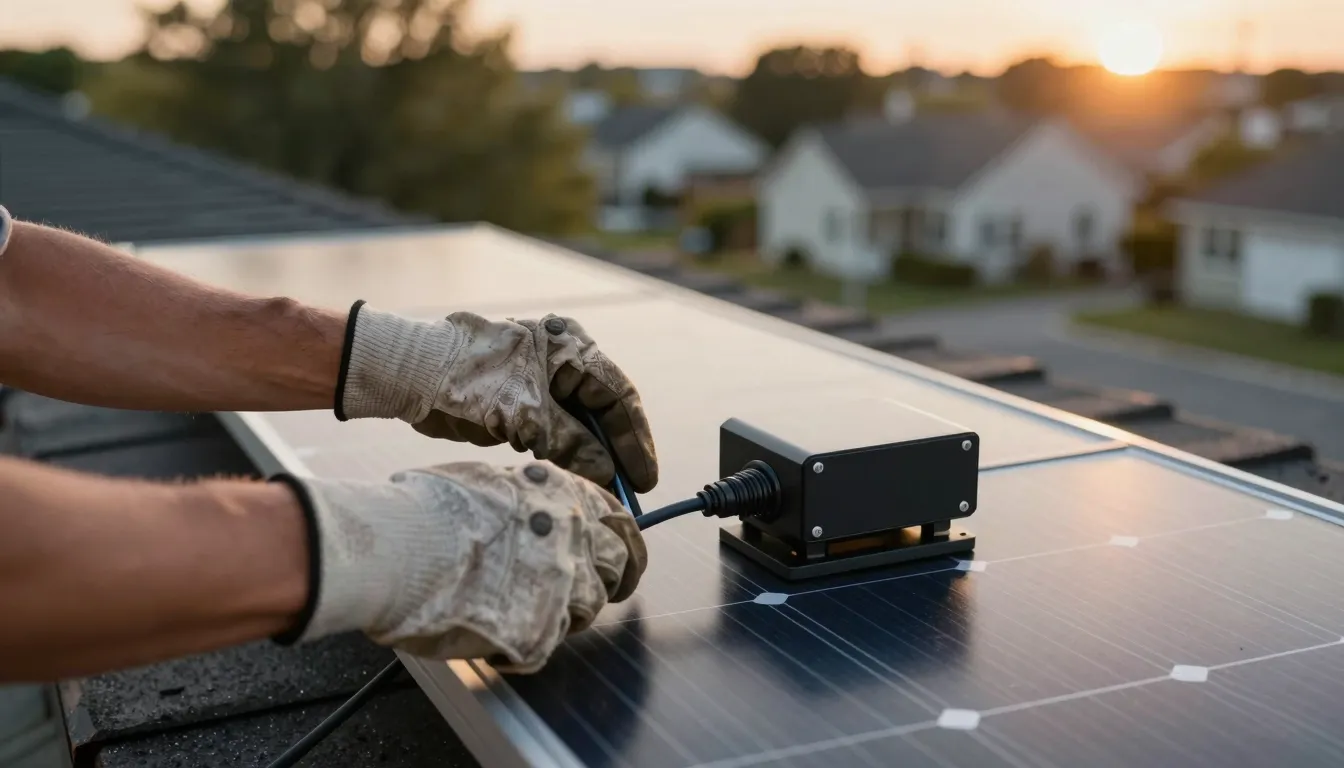
At their core, RV solar panels are photovoltaic modules designed to bolt onto a vehicle roof or deploy via ground stands to charge a localized battery bank. Unlike grid-tied home arrays, an RV system operates entirely off-grid, running at 12V, 24V, or 48V to store power for lighting, refrigeration, and electronics. Per 2026 manufacturer datasheets, the industry standards are either rigid monocrystalline panels mounted in permanent parallel configurations, or portable, folding blankets designed to be manually deployed when parked.
The core operating concept is highly similar to modern plug-and-play solar systems or the Balkonkraftwerk setups currently popular in European apartments. You are generating decentralized power on a small scale to offset consumption that would otherwise mandate paying for campground shore power or running a heavy, exhaust-heavy gasoline generator. Power moves from the panel, down through a charge controller to safely regulate the voltage, and directly into the rig's deep-cycle house batteries.
When you browse RV solar panels for sale, you will find most residential-grade camper modules range from 100 watts up to 400 watts per panel. Crucially, these panels do not power your 120V wall outlets directly. Instead, they continually replace the energy in your battery bank, allowing a separate, critical component—an inverter—to pull that stored 12-volt DC power and flip it into the standard 120-volt AC power that runs a laptop or microwave.
How Many Solar Panels Do You Need for Your RV? (Calculating Your Off-Grid Power Needs)
Sizing your array requires calculating your daily consumption in watt-hours (Wh) rather than guessing an arbitrary panel count. Based on US Energy Information Administration data, a stationary US home consumes around 30,000 Wh (30 kWh) daily, but taking an RV off-grid requires extreme efficiency. Most standard off-grid camper configurations consume just 1,500 to 3,000 Wh per day to cover a 12V compressor refrigerator, LED lighting, a water pump, roof vent fans, and basic device charging.
To determine exactly how many panels your lifestyle requires, you must add up the total daily baseline watt-hour consumption of your specific appliances.
| Common RV Appliance | Estimated Daily Consumption (Watt-Hours) |
|---|---|
| 12V Compressor Refrigerator | 300 – 600 Wh |
| LED Lights & 12V Water Pump | 100 – 150 Wh |
| Roof Vent Fans (Maxxair/Fantastic) | 150 – 300 Wh |
| Laptop/Phone Charging Network | 150 – 250 Wh |
| Microwave (5 to 10 minutes total use) | 100 – 200 Wh |
If your daily draw totals 2,000 Wh, you must generate that exact amount during your limited peak sun hours. According to NREL PVWatts location data, a standard US location provides roughly 4 to 5 peak sun hours per day. A 400W solar array operating at a realistic 75% efficiency (accounting for flat mounting angles and system heat loss) will yield roughly 1,200 to 1,500 Wh daily. Therefore, per 2026 installation math, covering a 2,000 Wh demand realistically requires a minimum 600-watt array paired with at least 200 amp-hours of usable lithium battery storage.
Can Your RV Air Conditioner Run on Solar? (The Truth About High-Draw Appliances)
Technically, yes, but the harsh financial and spatial realities make it completely impractical for most rigs. A standard 15,000 BTU roof-mounted RV air conditioner draws roughly 1,300 to 1,800 watts continuously while the compressor is running. Running that cooling unit for just five hours consumes up to 9,000 Wh (9 kWh)—more than triple the daily power consumption of the rest of the camper combined. You cannot plug an air conditioner into a basic 200W kit and expect a cool breeze.
Attempting to run an air conditioner solely on solar means scaling your entire architecture drastically. You need a massive battery bank (often 600 to 1,000 amp-hours of lithium storage), a 3,000-watt heavy-duty pure sine wave inverter, and an RV roof completely blanketed in high-output panels—usually a minimum of 1,200 watts. Even with maximum capacity, just two consecutive cloudy days will drain those massive reserves entirely.
Before attempting to cool a camper using sunlight, weigh the severe logistical trade-offs of scaling up your rig's electrical bay.
Pros
- Unlocks climate control without running a loud, exhaust-heavy generator.
- Delivers true remote independence in warm climates.
- A system large enough for A/C effortlessly powers other heavy appliances like induction cooktops.
Cons
- Requires $5,000 to $10,000+ in premium lithium batteries and oversized inverters.
- Robs all available roof real estate, crowding out fan vents and cellular antennas.
- Demands heavy gauge 4/0 wiring that is incredibly stiff and difficult to retrofit into existing walls.
There is also one fatal equipment error off-grid beginners constantly make when trying to cool off: ignoring the initial electrical surge.
From Sun to Watts: How RV Solar Panel Systems Work and Charge Your Batteries
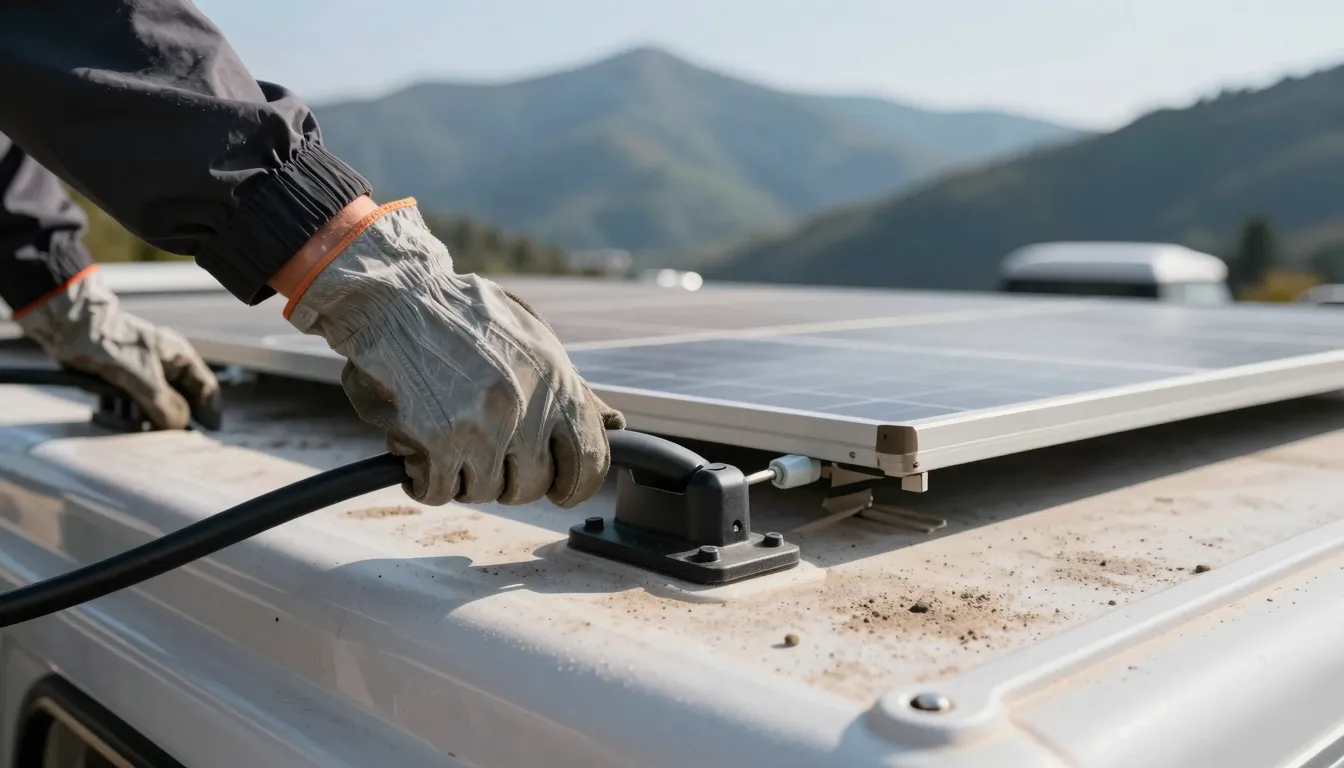
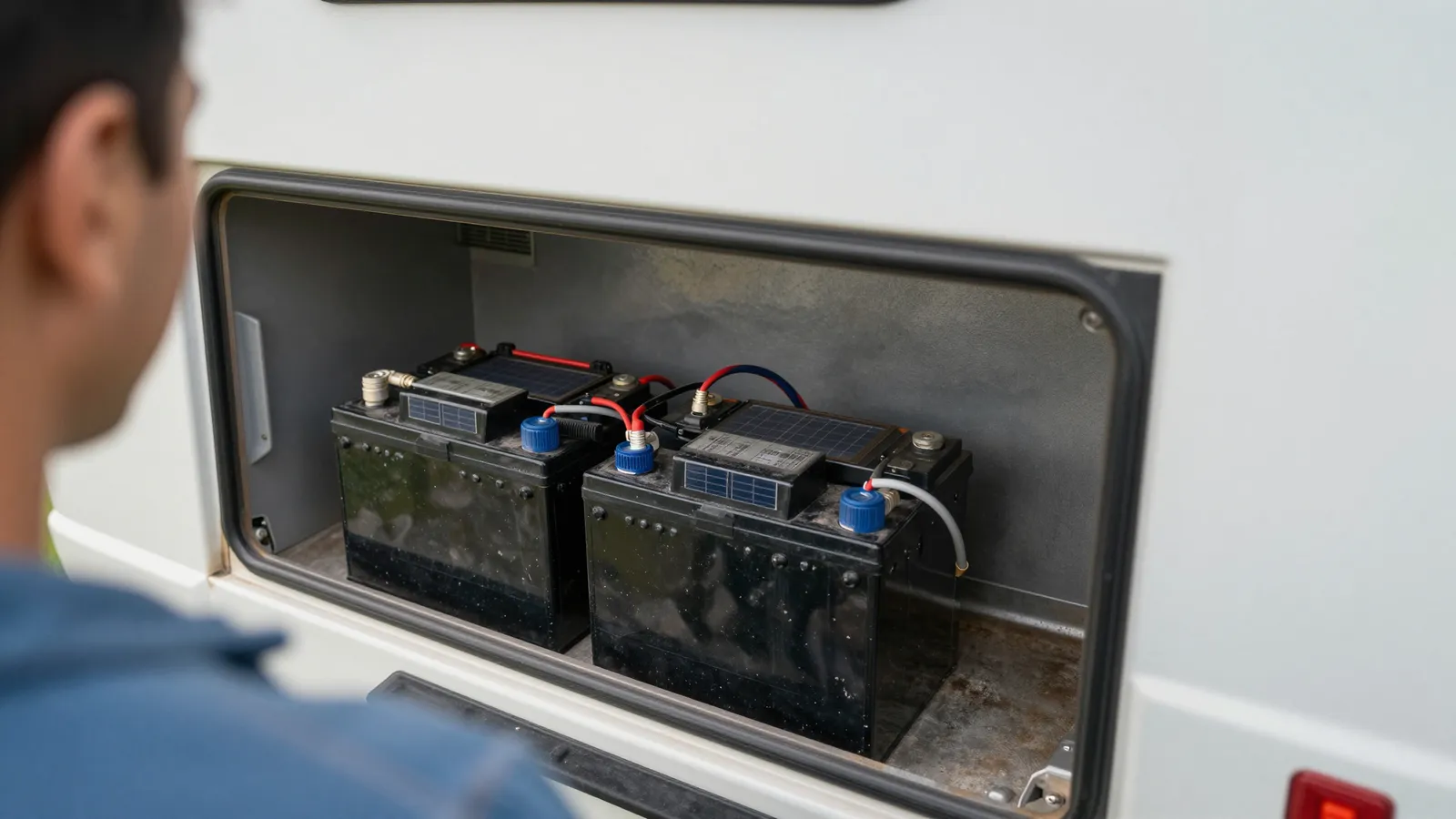
A safely functioning RV solar layout requires four strict components to move raw power from the sun over to your appliances: photovoltaic panels, a charge controller, a deep-cycle battery bank, and a power inverter. When direct sunlight hits your panels, it generates high-voltage direct current (DC). This raw power is much too volatile to feed straight into your 12V rig, demanding a smart intermediary. A solar charge controller steps in to regulate that fluctuating voltage down to a safe, steady rate (usually around 13.6V to 14.4V) before injecting it into the battery cells.
High-end modern charge controllers utilize MPPT (Maximum Power Point Tracking) technology. Based on 2026 system specs, MPPT controllers squeeze up to 30% more usable power out of your roof array than cheaper, outdated PWM (Pulse Width Modulation) controllers because they continually adjust the input voltage to perfectly match the battery’s real-time state of charge.
Once power rests safely inside the batteries, a robust inverter is wired inline to pull the 12V DC power and transform it into 120V AC. Rather than piecing components together with guesswork, many owners eliminate electrical risk by purchasing an rv solar panel kit with battery and inverter matched by the manufacturer. These bundles guarantee that the controller amp rating handles the panel's max voltage output, and the battery discharge speed matches the inverter's surge demand, avoiding melted terminals under heavy loads.
Are RV Solar Panels Worth the Investment? (Cost Savings and Off-Grid Freedom)
Calculating the true financial return on an RV solar system depends squarely on your specific travel habits. For occasional weekend travelers who exclusively stay at private full-hookup RV resorts, solar hardware is an unnecessary and costly redundancy. The legitimate payday applies only to 'boondockers'—travelers who prefer to camp off-grid on public BLM (Bureau of Land Management) land, in national forests, or at unimproved campsites lacking shore power.
Examining 2026 retail spaces, a quality 400W roof kit with a 30A MPPT controller costs roughly $500 to $700. Stepping the system up by adding a 200Ah lithium iron phosphate (LiFePO4) battery and a 2,000W inverter pushes your total self-installed hardware cost to approximately $1,600 to $2,000. If an average hookup campsite runs $60 per night, and dry camping off-grid is free, you reach a direct break-even point on the hardware investment after 27 to 34 nights spent off-grid.
Beyond directly skipping campground fees, an adequate array saves hundreds in generator fuel and engine maintenance. A portable 2,000W generator burns through roughly a gallon of gasoline every six to eight hours. If a boondocker relies on solar for 40 days a year instead of petroleum, they eliminate significant fuel costs while maintaining a silent campsite—a strict requirement enforced by many state park generator noise curfews.
Understanding RV Solar Panel Kits: What to Check Before You Buy
When shopping for power components, ignore exaggerated marketing output numbers and inspect the raw datasheets. A safe baseline is avoiding generic resellers and sticking to established brands boasting clean electronics and proper UL hardware listings. From tempered glass rigid panels by Victron and Renogy, to flexible Dometic RV solar panels manufactured for curved airstream roofs, the form factor you pick dictates your installation limits. While flexible panels are lightweight and require no roof drilling, they possess a major flaw: they trap intense heat violently against the roof surface, drastically lowering their output efficiency and shortening their lifespan to roughly 3 to 5 years.
Before hitting checkout, verify the Open-Circuit Voltage (Voc) listed on the panel spec sheet. Your selected charge controller must be rated to accept a voltage strictly higher than the combined maximum voltage of your overall array under freezing conditions—because cold weather forces voltage to spike. If you string two 24V panels in series, generating a 48V Voc, but the supplied controller only tolerates 40V maximum input, a morning frost will permanently fry your equipment.
Lastly, inspect the wiring gauge provided in the kit. Countless budget packages ship with thin 12 AWG wire to string moving power twenty feet down from a roof, causing huge power loss due to voltage drop. Addressing poor wiring and mounting hardware is the pivotal first step in executing a proper rv solar panel installation, making absolutely certain your panels do not rip out of old fiberglass at highway speeds. For safety reasons, any complex alternating-current (AC) wiring integration inside the camper should be inspected by a licensed electrician.
Optimizing Your RV Solar Setup: Tips for Maximizing Energy Production
Even the most expensive rigid arrays underperform if they are positioned poorly against the winter solstice. Rigid panels mounted completely flat on an RV roof almost never hit their printed STC (Standard Test Conditions) wattage values. The flat orientation dictates that sunlight strikes the cells at a deeply oblique angle during mornings or winter months, heavily reducing your yield by 20% to 30%. To counter this baseline loss, many boondockers utilize tilting roof brackets, manually angling the array directly into the southern sky during stationary stays.
If drilling expensive tilting mechanisms into a membrane roof is undesirable, supplemental portable ground pods are an excellent fix. Portable blankets function exactly like mini / micro solar, plug-in solar, or apartment / renter solar kits—deployability and aiming flexibility matter more than heavily fixed infrastructure. Simply park your RV deep under the shade of trees to keep the interior cool, while running a heavy 30-foot extension line (10 AWG minimum size) out to a portable panel basking directly in the open sun.
Avoiding hard shading is the final critical step. RV roofs are cluttered with raised topography like air conditioner shrouds, plumbing exhaust pipes, and cellular antennas. If a thin black plumbing pipe casts a severe, hard shadow across just ten percent of a rigid solar panel, the production of the entire panel drops to a crawl. Wiring roof panels in a parallel configuration, rather than in series, ensures that when one panel gets shaded by a roof vent, the other unshaded panels can continue injecting unthrottled power into the battery bank.
Sources: Technical load modeling and off-grid panel capacities correspond with 2026 calculations extracted from NREL PVWatts insolation indexes and US Dept. of Energy sizing criteria. Hardwired architectures and voltage wire gauges reference current National Electrical Code (NEC) safeguards. Payback and investment numbers trace average 2026 listed retail marketplace pricing for class leading RV electrical components.
How many solar panels do I need to run a RV?
A standard off-grid RV running a 12V refrigerator, LED lights, ventilation fans, and laptops requires roughly 1,500 to 2,000 watt-hours a day. To reliably generate this amount accounting for system heat loss and cloudy days, you need a minimum of 400 to 600 watts of solar capacity, which equates to two or three standard 200W rigid panels per 2026 hardware sizing.
Can I run my RV air conditioner on solar power?
Yes, but strictly from massive battery banks rather than directly off the roof panels—and it requires an incredibly expensive hardware upgrade. A roof AC unit pulls a massive 1,500 continuous watts (and often surges to 3,000+ watts when kicking on). Running it off-grid typically requires a 3,000W inverter, 600 to 1,000 amp-hours of high-end lithium batteries, and 1,200W+ of solar arrays just to slowly recharge what the AC drains. It is not feasible for small pop-ups or budget rigs.
How long does it take a 400W solar panel to charge a 12V battery?
Assuming 4 to 5 peak sun hours per day, a 400W array produces roughly 1,200 to 1,500 watt-hours (translating to about 100 to 125 amp-hours replaced at 12V). Therefore, it typically takes a 400W system one full, sunny day to completely recharge a heavily depleted 100Ah lithium battery.
Are solar panels worth it on a RV?
Yes, they are highly cost-effective for boondockers. A $1,600 to $2,000 investment in a self-installed 400W solar kit with an inverter and lithium battery will quickly pay for itself within roughly 30 total nights of dry camping by saving you the baseline $60 a night required to hook up at standard private RV campsites.